Not just a technological shift, but a kind of cultural and aesthetic change of era

Gábor Petrusán is the business manager responsible for Coninvest’s domestic projects. In his work, he deals with commercial kitchen developments on a daily basis, where operational safety, energy efficiency, and long-term decisions are not theoretical issues, but very tangible business factors.
He draws on his experience from active projects, completed kitchens, and operator feedback. This practical experience gave rise to the following article, which examines the role of induction technology in 2026 not as a trend, but as a basis for decision-making.
When did induction become the new standard?
The rise of induction technology did not happen overnight. Its spread was triggered by a combination of factors: growing demand for energy efficiency, improvements in the working environment, and the increasing importance of cleanability in line with HACCP requirements.
With the drastic change in energy prices, the issue of efficiency became a decisive factor for operators. While the efficiency of induction cooking is approximately 90%, traditional gas-powered solutions typically only achieve 40-50%. This difference is significant not only in terms of cost, but also in terms of kitchen heat load, comfort, and predictability of operation.
Induction does not heat up the kitchen unnecessarily, so the air conditioning system has to work less, and chefs are less tired in 40-degree heat. Cleaning a flat glass surface takes only a few minutes, compared to the cast iron grates of gas burners.
Five to eight years ago, chefs were still wary of induction due to the lack of the familiar flame, but today, precision and accurate settings have become more important.
Don’t bury gas, put it in its place!
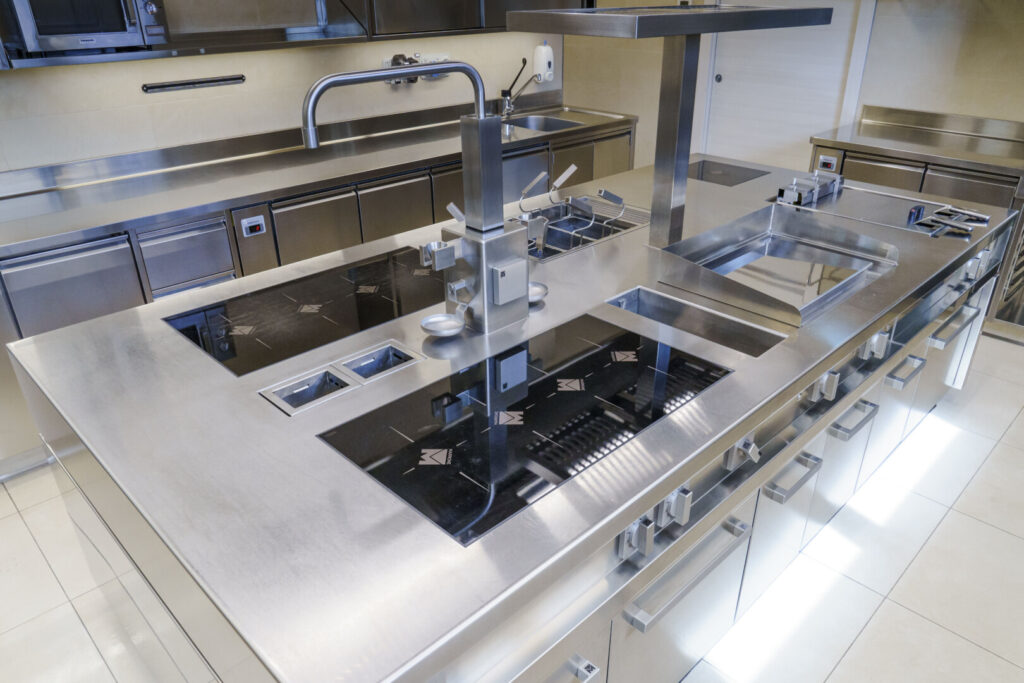
Gas cooking can be the jewel in the crown of an open kitchen. A design element that offers an unparalleled feeling of life. A gas stove with robust knobs, such as a unique Marrone cooking block, is not just an appliance, but a status symbol. An induction hob is sterile. The dance of the gas flames and the patina of the metals give the kitchen soul. Gas is sure to remain on the fine dining stage or in traditional establishments where guests can see the cooking process.
Why is 2026 the year of the “explosion”?
Tighter EU regulations (Energy Efficiency Directive)
By 2026, the European Union’s Energy Efficiency Directive (EED) will no longer be just a recommendation, but a regulation that will have a significant impact on everyday operations. Mandatory energy reduction targets have been set for member states, which directly affect the hospitality industry through the Green Deal framework.
As a result, maintaining gas-powered kitchens is becoming increasingly expensive due to higher emissions and lower efficiency. Due to stricter environmental classifications and the associated taxes and operating costs, gas-based technologies are becoming less advantageous not only from an energy perspective, but also from an economic perspective.
The era of “AI-connected” kitchens
In 2026, induction technology will be much more than just a hob. The new generation of appliances will come with smart sensors and built-in AI assistance that actively support kitchen workflows.
One such feature is pot recognition, where the system accurately identifies the pot being used and automatically recommends – or, if necessary, sets – the optimal temperature.
This also includes communication between appliances: the hob “cooperates” with the extractor hood in real time and automatically adjusts the extraction rate based on the cooking intensity, and is able to exchange data with other kitchen appliances, such as ovens.
Smart features also appear in the area of maintenance. Fault prevention systems continuously monitor the condition of components and send timely signals to the service department before a malfunction can shut down the kitchen during peak hours.
Labor shortages and the “Cool Kitchen” concept
The competition for chefs will remain a critical factor in the hospitality industry in 2026. Modern chefs no longer want to work in smoky gas kitchens at 45 degrees Celsius, where the physical strain alone limits their performance and concentration.
The issue of heat stress has therefore become a priority. Thanks to the approximately 90% efficiency of induction technology, most of the heat remains in the pot and does not enter the kitchen airspace. This not only creates a more comfortable working environment, but also reduces the need for extraction and the associated energy consumption.
Induction cookers also offer precise, digital control. This is particularly important when training junior chefs: there is less room for error, settings can be reproduced, and the cooking process is based on precise parameters rather than “eyeballing” it.
By 2026, switching to induction will no longer be a matter of courage, but a sensible business decision. Those who fall behind will not only waste energy and money, but also risk losing talented chefs of the future to competitors with more modern, people-centered kitchens.
Energy efficiency: when the numbers speak for themselves
For a long time, there was a misconception that gas was cheaper. However, by 2026, the energy market and technology had reached a point where induction was not only faster but also more cost-effective in numerical terms.
In terms of efficiency, the most important difference between the two technologies is the amount of energy wasted. While with a gas flame, a significant amount of heat escapes from the pot (heating the kitchen and the cook), induction works in a targeted manner.
| Feature | Gas hob | Induction technology |
|---|---|---|
| Energy consumption efficiency | ~35-40% | ~85-90% |
| Heat loss to the environment | High (above 60%) | Minimal (~10%) |
| Boiling time (2 l water) | ~8-9 minutes | ~4 minutes |
The use of induction results in savings on several levels. On the one hand, the system only consumes energy when there is actually a pan on the hob – there is no “idling” flame burning between two orders. This alone makes a significant difference in daily energy consumption.
On the other hand, since induction technology does not heat the air in the kitchen, the load on exhaust and air conditioning systems is also reduced. Experience shows that these systems require up to 30-40% less energy in induction kitchens. In 2026, with cooling costs continuing to rise, this is no longer a negligible item, but a key issue for operations.
The return on investment is also clearly visible in the figures. In a commercial kitchen with average turnover, the switch from gas to induction typically pays for itself in 18-24 months, taking into account lower energy consumption and reduced service costs. After that, the equipment generates direct savings, i.e., “pure profit” for the operator through lower utility bills.
In modern gastronomy, the biggest enemy is chance. Chefs’ new superpowers are therefore precision and predictability. In 2026, guests will rightly expect their favorite dishes to be served with the same quality on Tuesday as on Saturday. Induction gives the kitchen control with the precision of a pharmacy scale.
While the heat intensity of a gas flame can be influenced by a number of external factors, such as gas pressure or draft, each level on the scale from 1 to 10 (or even 100) on an induction hob represents a fixed, reproducible value.
One of the biggest advantages is the fast response time. With induction, heat transfer stops immediately when the power is turned off, so there is no inertia and no residual heat to continue cooking the food. This level of control is particularly critical for sensitive ingredients such as chocolate, fish, or egg-based creams.
A predictable work pace is not only a question of quality, but also a mental one. A significant part of kitchen stress comes from when things are not running smoothly. One of the biggest advantages of 2026 induction technology is that heating times can be reproduced with split-second precision, enabling precise timing of kitchen processes and a stable service pace.
Sustainability: not marketing, but strategy
Sustainability has long been a communication tool, but today it is increasingly becoming an operational and investment consideration. Electric induction systems can be integrated into energy strategies based on renewable sources, optimized consumption, and lower emissions.
With gas, not only carbon dioxide emissions but also indoor air quality are becoming a major issue. From this perspective, induction is a cleaner, more controllable and, in the long term, risk-reducing solution.
Technological maturity: induction is no longer a compromise
It is important to note that induction is no longer an alternative, but a fully-fledged professional kitchen technology. In recent years, industrial manufacturers have made significant advances in performance, load capacity, and control, making induction a true commercial kitchen solution.
A good example of this is that new-generation appliances, such as the latest series from MKN, now offer features such as core temperature sensing, which further increases the accuracy and reproducibility of the cooking process.
Today’s commercial induction systems are suitable for continuous, high-volume operation, can be integrated into digital management and monitoring systems, and comply with increasingly stringent international regulations. All this makes it clear that induction is not a compromise, but a conscious, long-term professional decision.
Looking ahead: what will this mean in 2026?
The electrification of commercial kitchens will not happen overnight. However, it is clear that by 2026, induction will no longer be a technological issue, but rather a basic requirement for responsible operators. It may not be the only solution in every case, but it will almost certainly be an indispensable strategic element.
We believe that good kitchen technology is not an end in itself, but creates operational safety, predictability, and true future-proofing. Induction represents exactly that: a direction where economy, sustainability, and the human factor are finally not at odds with each other, but pointing in the same direction.