Advice from István Dybisewszky, Coninvest’s designer
One of the simplest-seeming yet most complex tasks in kitchen design is planning the bar counter. From the outside, it is a visual feature; from the inside, however, it is a heavily used workspace that coordinates multiple functions, where every centimeter and every decision counts. Experience shows that most operational issues related to bar counters do not arise during use, but are determined as early as the design phase.
How we arrived at today’s solutions
At Coninvest, the design and construction of bar counters have undergone significant changes over the past twenty to twenty-five years. Previously, ready-made, pre-designed Italian systems dominated the market, integrating technology, workspace, and aesthetics into a single unit. These were compact, durable, and easy-to-clean solutions that represented consistent quality.
Over the years, however, domestic designers and manufacturers have also risen to this level. Today, in many cases, unique, domestically manufactured solutions are created that are more cost-effective while better adapting to interior design concepts. This provides greater freedom in design, but also greater responsibility, as one must oversee the entire system.
A bar counter is not a piece of furniture, but a system
It is now clear that a bar counter cannot be made exclusively from wooden furniture. Due to water, constant use, and hygiene requirements, a stable load-bearing structure is necessary, which is usually a metal frame. This forms the base of the counter, onto which the various surfaces and finishes are applied.
In practice, two distinct approaches can be identified. In one case, the visual aspect takes center stage, and various tools and counters are simply “shoved” behind the front counter, with the idea that the guest won’t see them anyway. These solutions may work in the short term, but in the long term they result in systems that are difficult to clean, chaotic, and problematic from a hygiene standpoint.
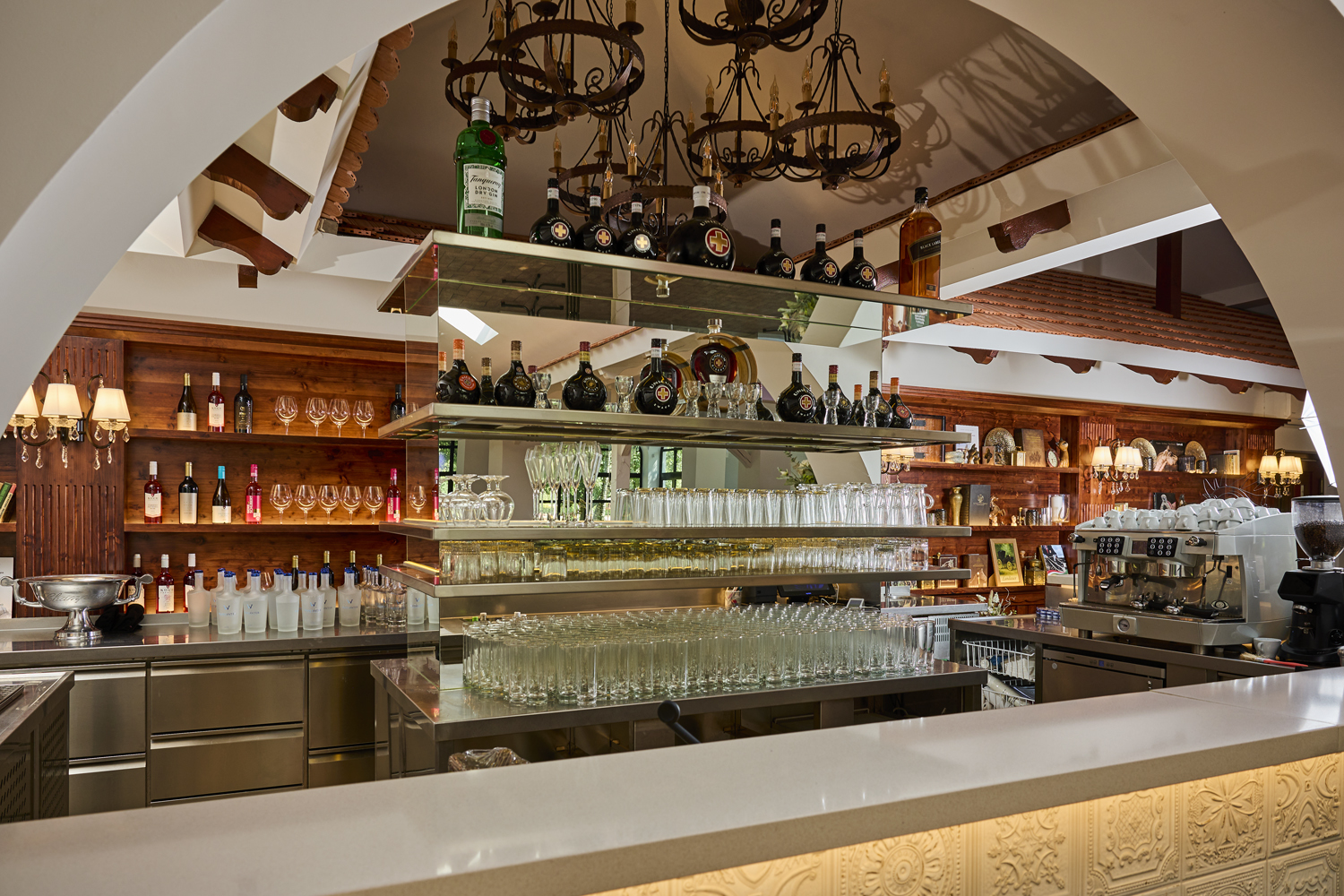
The other approach is based on a compact, enclosed system where the front panel is seamlessly integrated with the frame structure, and the areas beneath the work surfaces are also constructed from waterproof, typically stainless steel materials. Here, there is nowhere for water or dirt to seep in, and the interior of the counter remains tidy and easy to keep clean. This approach ensures more stable and sustainable operation in the long term.


Where multiple areas of expertise converge
The bar counter is one of the most complex elements in a restaurant, as it brings together the work of multiple disciplines at once. In addition to kitchen engineering design, it involves metal fabrication, carpentry, stone cladding, and in many cases, specialized metalworking, as well as the installation of electrical systems.
Clients often underestimate the complexity of this coordination. Even for experienced contractors, it is not easy to perfectly coordinate every detail on the first try. If multiple separate subcontractors are working on the project, it can easily happen that a particular element does not end up exactly where it should, which later results in redesigns or additional costs. That’s why, in practice, it’s often advantageous to keep the process as centralized as possible.
The most common mistake: not enough space
One of the most typical design problems is a bar counter that’s too small. We often encounter the idea that a three-meter section can accommodate every function, while actual needs require much more space.
Even for a counter performing basic bar functions, coffee machines, grinders, milk coolers, and hand-washing stations alone require significant space. Add to this refrigerated counters, beer taps, dishwashing areas, cocktail stations, ice machines, wine coolers, blenders, and other equipment. When you put all of these side by side, it quickly becomes clear that the required space can be as much as eight linear meters. If both the front and back counters are actively used, a counter at least four meters long is required for a well-functioning system.
Balancing aesthetics and functionality
Interior design trends often favor curved, wavy, or organic shapes. These are visually striking solutions, but in practice they often reduce the usable workspace. Although there are specialized fixtures that can follow these curves, most equipment is fundamentally designed for straight-line configurations. Therefore, every design decision must be weighed against how much it compromises functionality.


Platform or no platform
The question of whether to have a platform behind the bar counter also comes up frequently. A common solution in Mediterranean countries is to create a raised surface behind the counter, which facilitates service and improves visibility of the dining area. It also has ergonomic benefits, as staff do not have to stand on a hard surface all day.
However, poorly designed podiums can cause serious problems. If constructed improperly, water and dirt can seep under the structure, leading to hygiene and structural issues over time. Truly durable solutions are made with special, waterproof coatings and sealed joints. If construction of this quality is not feasible, in many cases it is a better decision to forgo the platform and improve ergonomics and cleanability in other ways.
Cleaning, maintenance and lighting
Cleanability is a key consideration in bar counter design. Easily accessible surfaces, sealed structures, and the use of appropriate materials all contribute to making daily cleaning quick and efficient. Equally important is proper electrical design, particularly the use of waterproof connectors.
Lighting is also a critical factor. Ambient lighting in the guest area is often subdued, but staff working behind the counter need to see exactly what they are doing. Therefore, targeted lighting of work surfaces is essential. Well-placed light sources not only facilitate work but also enhance operational safety.


It’s worth thinking ahead
The bar counter serves both as a visual focal point and a heavily used workspace. Successful operation doesn’t depend on chance, but rather on how well technology, ergonomics, space utilization, and the work of different departments are coordinated during the design phase.
The evidence is clear. Most operational problems do not arise during use, but are born at the drawing board. However, if the system is well thought out from the start, the bar counter will operate efficiently, cleanly, and economically in the long term.