The background became the protagonist
Why is renovating a basement kitchen so special?
We have previously written about the renovation of Déryné’s kitchen in Coninvest’s references. We wrote about the thinking, openness, and professional curiosity that characterized Kristóf Kovács’s work and the joint design process. In that story, the focus was on the kitchen concept organized around the fire, the inspirations, and the experiences closely related to the guest area.

This article takes us one level down, literally. To the Déryné’s basement kitchen. To the background world that is rarely seen, yet fundamentally determines the operation of the restaurant. In the case of an iconic place, the renovation of a kitchen is never purely a technological issue, but the renovation of a basement kitchen is a particularly sensitive task. It is not just a matter of machines and coverings, but of how to raise a windowless space operating one level below ground to the highest possible level in terms of hygiene, functionality, and human comfort.
“The cellar is always a neuralgic point. If it is in order, then everything upstairs runs more smoothly,” says Kristóf.
In January 2025, the time had come for the back-of-house areas operating on the basement level, the storage rooms, preparation areas, and the kitchen to be not only technically upgraded, but also to represent a new level of quality in terms of aesthetics and hygiene. The task was complex: a partial renovation in a continuously operating, live restaurant, with a construction period of only two and a half weeks.
Long preparation, conscious standards
The implementation was preceded by more than a year of planning and consultation. During this time, numerous professional discussions, debates, and inspirational meetings took place. During his travels abroad, Kristóf visited hotels, fine dining restaurants, and the kitchens of large-scale catering companies. In the summer of 2024, we visited the Marrone factory together. These experiences gradually shaped the standards that he ultimately wanted to implement in the Déryné cellar kitchen.
“I didn’t want half measures. I wanted a kitchen that didn’t need to be explained when anyone came down to see it,” says Kristóf.
The goal was not simply to renovate the kitchen, but to create a space that was pleasant to work in, that could be shown to guests and partners at any time, and that was sustainable in the long term in terms of hygiene and operation.
A new interpretation of the cellar: light, cleanliness, order
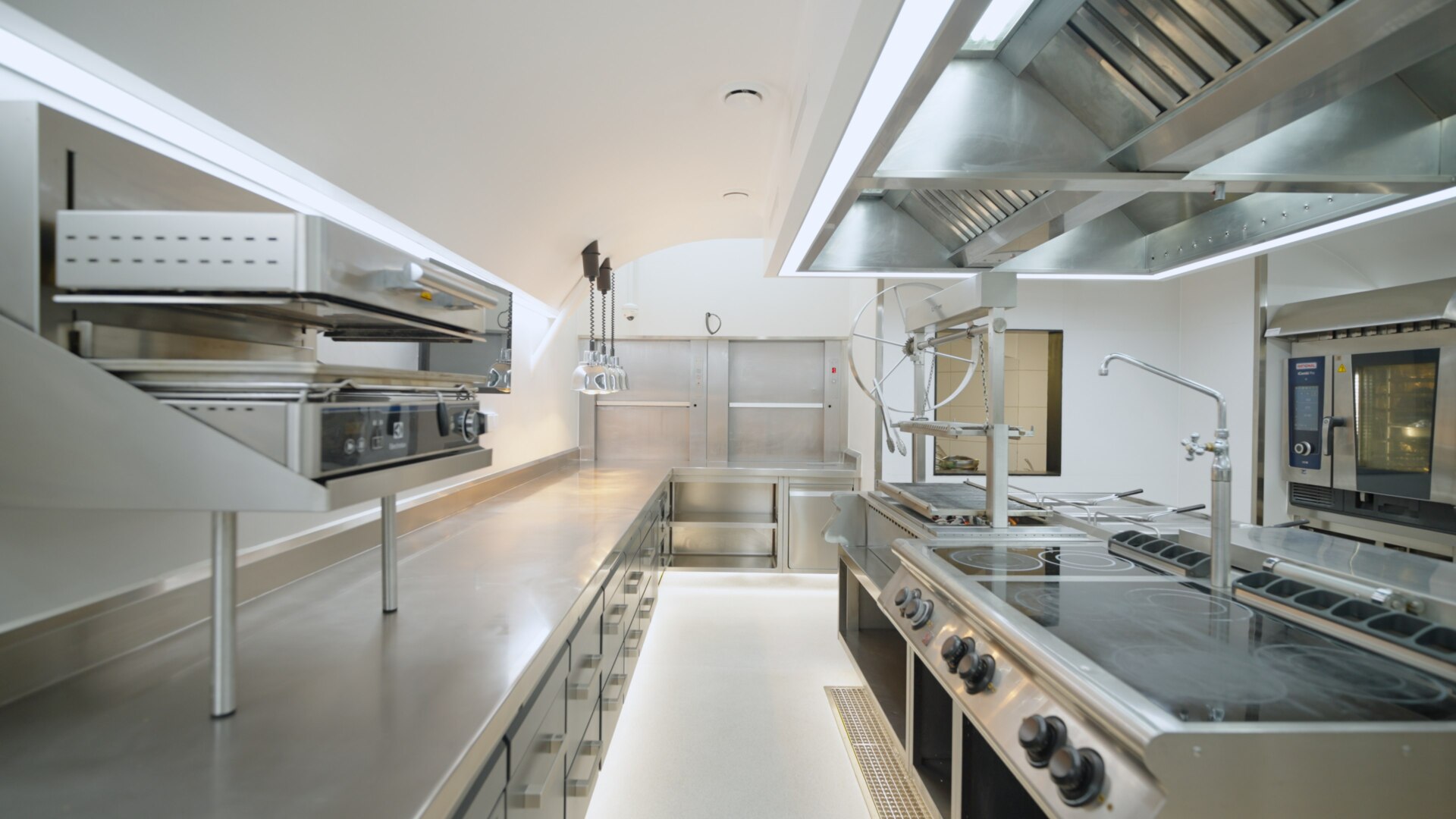
Today, Déryné’s cellar kitchen is much more reminiscent of the back rooms of a four- or five-star hotel than a classic restaurant basement. The lighting, coverings, and layout all reinforce this feeling.
The corridors are decorated with uniform black-and-white framed portraits. Déryné’s employees look back at us, accompanied by Kristóf’s motivational quotes. This gesture sends a clear message: the team working in the background is just as important to the restaurant as the colleagues visible in the dining area.
“It was important that the cellar wasn’t a punishment, but a place where it was nice to go to work. I believe that you should take care of your guests first, and then take care of your colleagues in the same way. The rest will follow almost automatically,” adds Kristóf.


Architectural and hygienic principles without compromise
One of the basic principles of the renovation was that the architectural solutions should consistently serve hygiene, without exception.
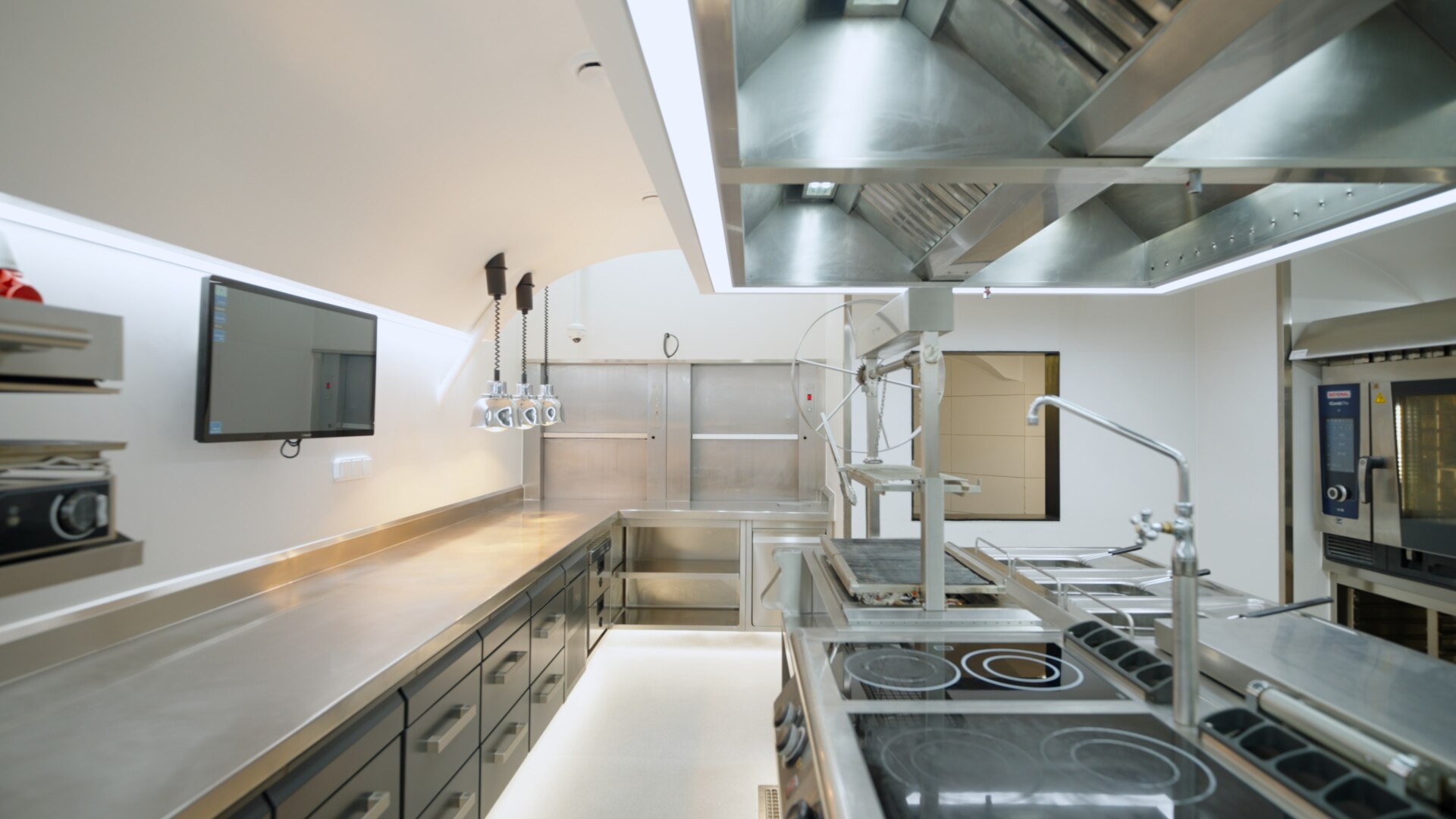
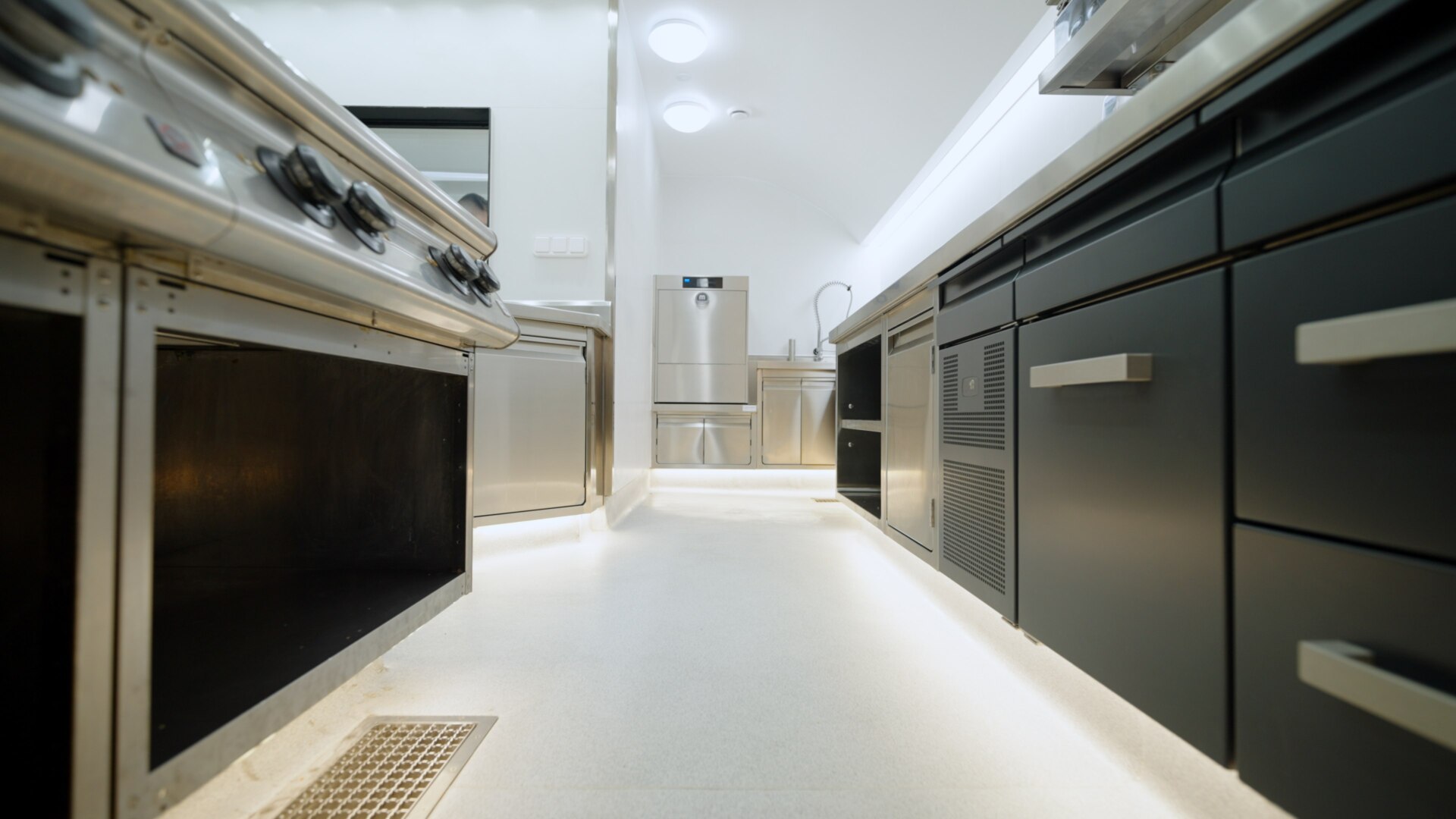
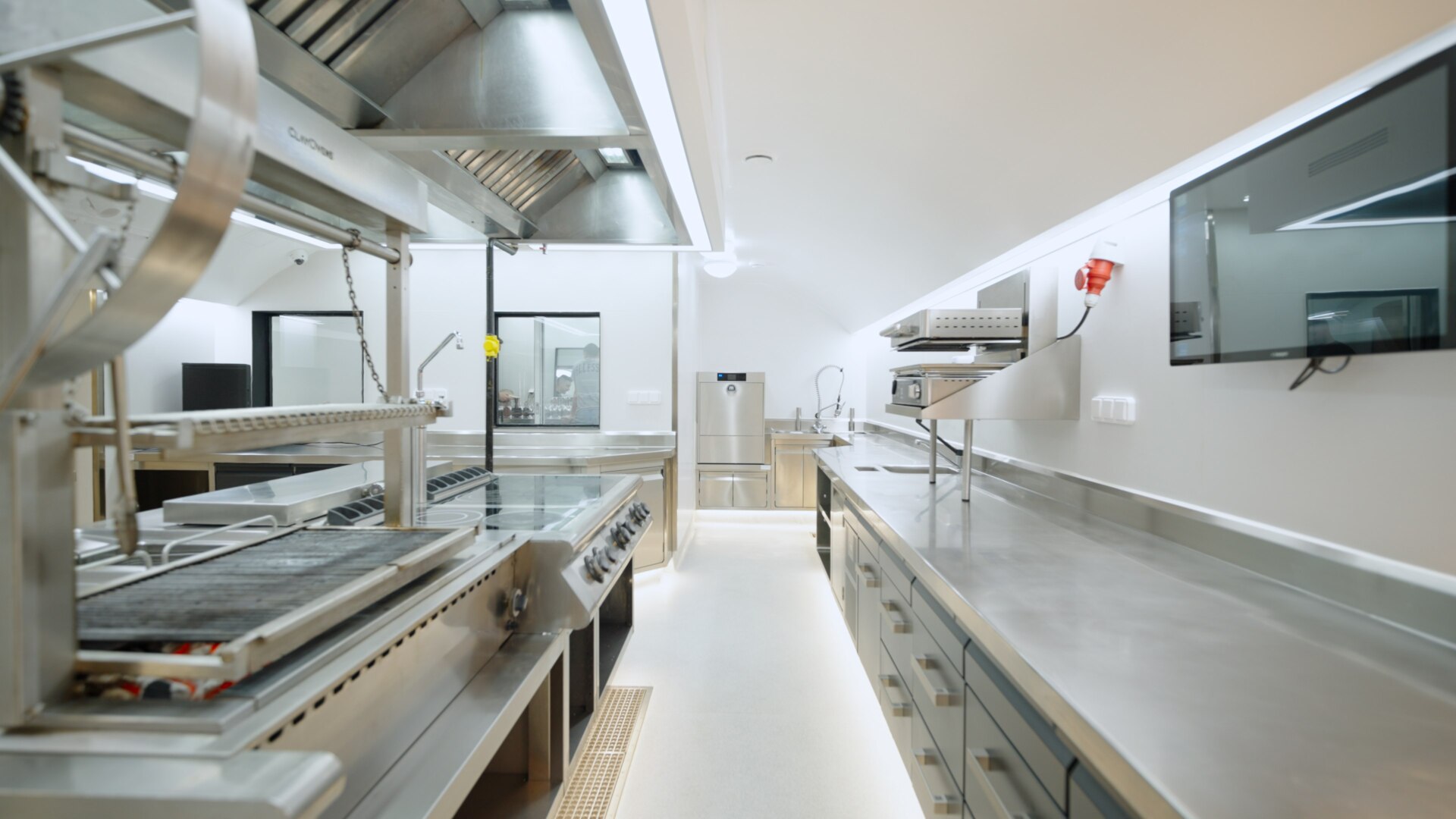
The work counters and cooking island were placed on concrete plinths, which Kristóf implemented not only in the central kitchen area, but also in the preparation rooms. The floor was designed without joints, with a holker at the junction of the floor and the plinths, creating a continuous, easy-to-clean surface.
The previous floor drains were replaced with genuine industrial, stainless steel, removable grate and filter insert solutions. We used slotted drains at several points, developed by ACO for warm flooring, with clamping flanges that completely prevent leakage under the flooring.
“I insisted that the drains be placed under the furniture. This way, colleagues don’t have to step on them, they’re not in the way, and there are no compromises. These are small things, but they matter on a daily basis,” explains Kristóf.
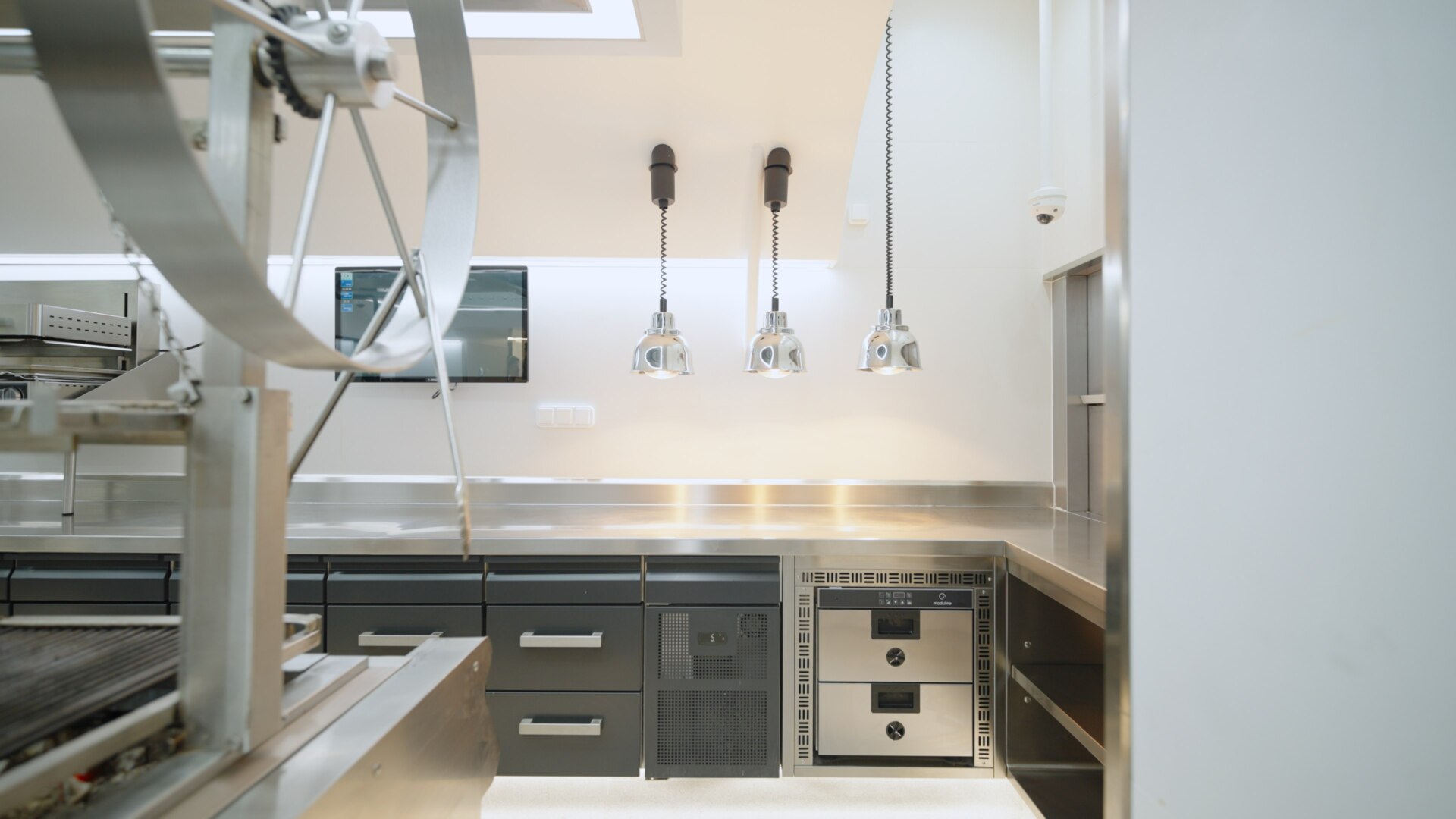
The stainless steel furniture protrudes beyond the plinths and is complemented by concealed lighting. The counters, drawers, and storage units are made to H2 hygiene standards, with welded radii that virtually eliminate the possibility of contamination and liquid ingress.
Design in the kitchen, because feeling matters here too
The stainless steel fronts of the main kitchen have been given a matte black sintering finish. The decision was not based on technological constraints, but on a very sincere idea.
“I just liked it that way. And I think a kitchen can have character too,” says Kristóf.
The handles on the drawers and doors are partly concealed and partly the distinctive design of Italian brand Marrone, especially on the refrigerators. The welded cover system has a fold-up edge in all directions, with a 45-degree angle at the wall connections. Underneath, there is a thin, practical row of drawers for storing utensils.
Digital order in the kitchen
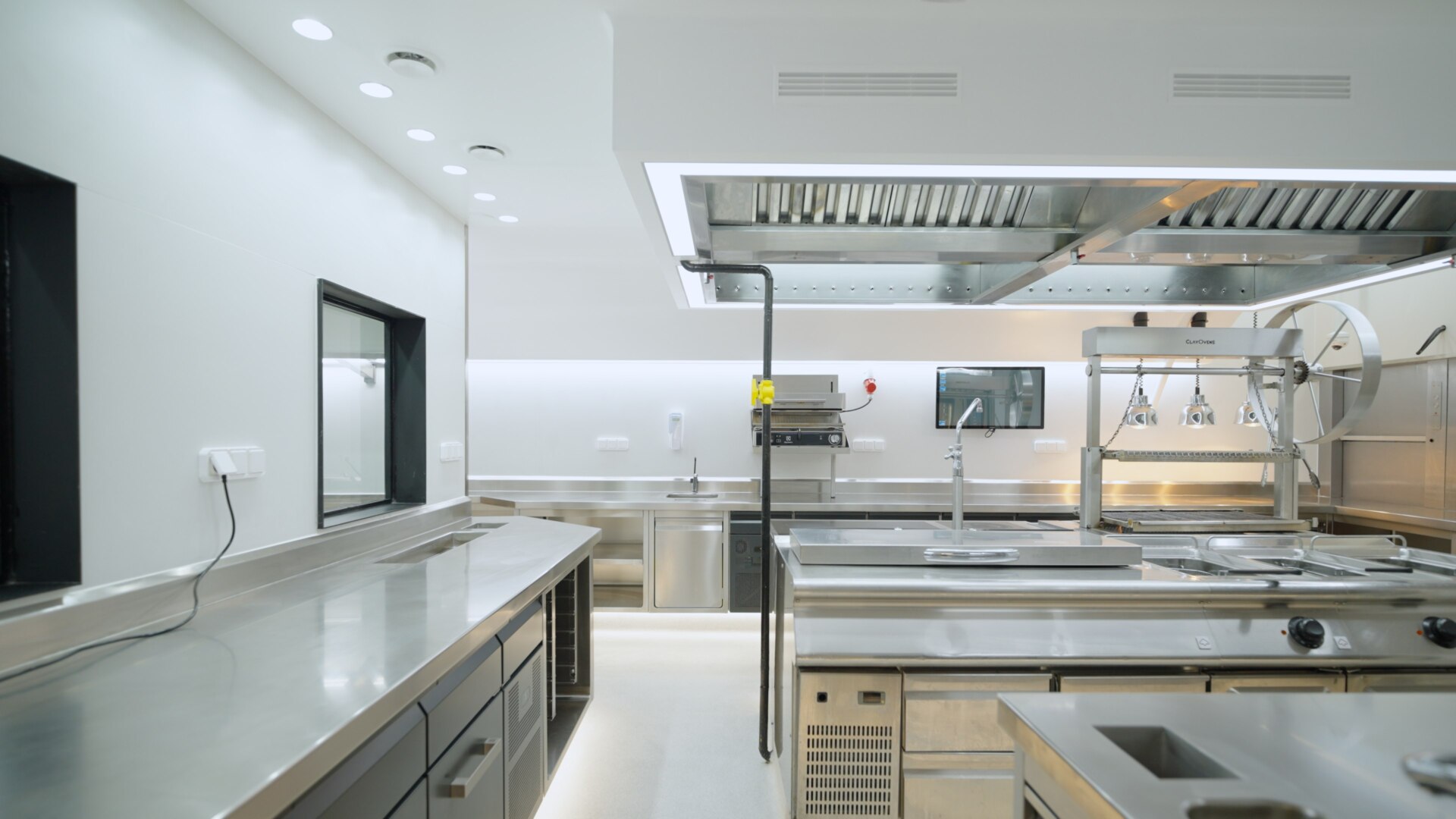
The transparency of the kitchen’s operation is aided by a spectacular double KDS touchscreen order management system.
“It was important that we didn’t work with papers, shouting, and memory. The KDS system brings discipline, creates clear situations, and everyone can see exactly where the kitchen stands,” says Kristóf.
Preserved values and new gestures
The central cooking island and extractor hood equipment have been retained, undergoing maintenance and partial renovation. New heat-resistant lighting fixtures have been installed in the hood, with new ventilation connections.
The curve of the vaulted side walls of the cellar is echoed in the circular cladding of the extractor hood, complemented by hidden LED lighting. New air conditioning units help to manage the heat generated by the charcoal grill.
The side walls have been covered with large, white Carrara marble-patterned tiles, naturally with a joint-free design. The overall effect is clean, bright, and surprisingly elegant, especially for a cellar kitchen.

Why is a basement kitchen like this?
The question rightly arises: why should so much attention, quality, and aesthetics be brought to a basement kitchen?
“Because this is where it all starts,” Kristóf replies. “If the background works, everything upstairs is calmer. Hygiene is fundamental. The well-being of colleagues is key. And yes, what someone feels when they first step in here also matters.”
Today, this space is not a compromise, but an asset. It is an environment that is pleasant to work in and worthy of the restaurant that lives and operates above it.
When the background takes center stage
The renovation of Déryné’s kitchen is one of the best examples for Coninvest that the quality of the background is not a luxury, but a conscious decision. With lengthy preparation, precise planning, and genuine teamwork, even a partial renovation can bring about a complete change in attitude.
It is no coincidence that Kristóf opened the reborn kitchen with a VIP party. Guests could walk around the space, which was previously invisible but is now one of Déryné’s most important assets, with champagne and crudo in their hands.
“At the end of the whole process, one of the most important lessons I learned was that there is now only one kitchen technology company that can truly meet our needs, and that is Coninvest,” says Kristóf.